In international trade, Raw Cashew Nuts (RCN) and Cashew Kernels are frequently discussed together, yet they represent two fundamentally distinct products within the cashew supply chain. Procuring the wrong category can stall production schedules for weeks, incur high re-processing costs, and disrupt critical delivery timelines.
This article offers a clear breakdown of the key differences between raw cashews and processed kernels, details the rigorous processing stages required to yield export-grade kernels, and highlights why Vietnam remains the premier global hub for international buyers.
What Are Raw Cashew Nuts (RCN)?
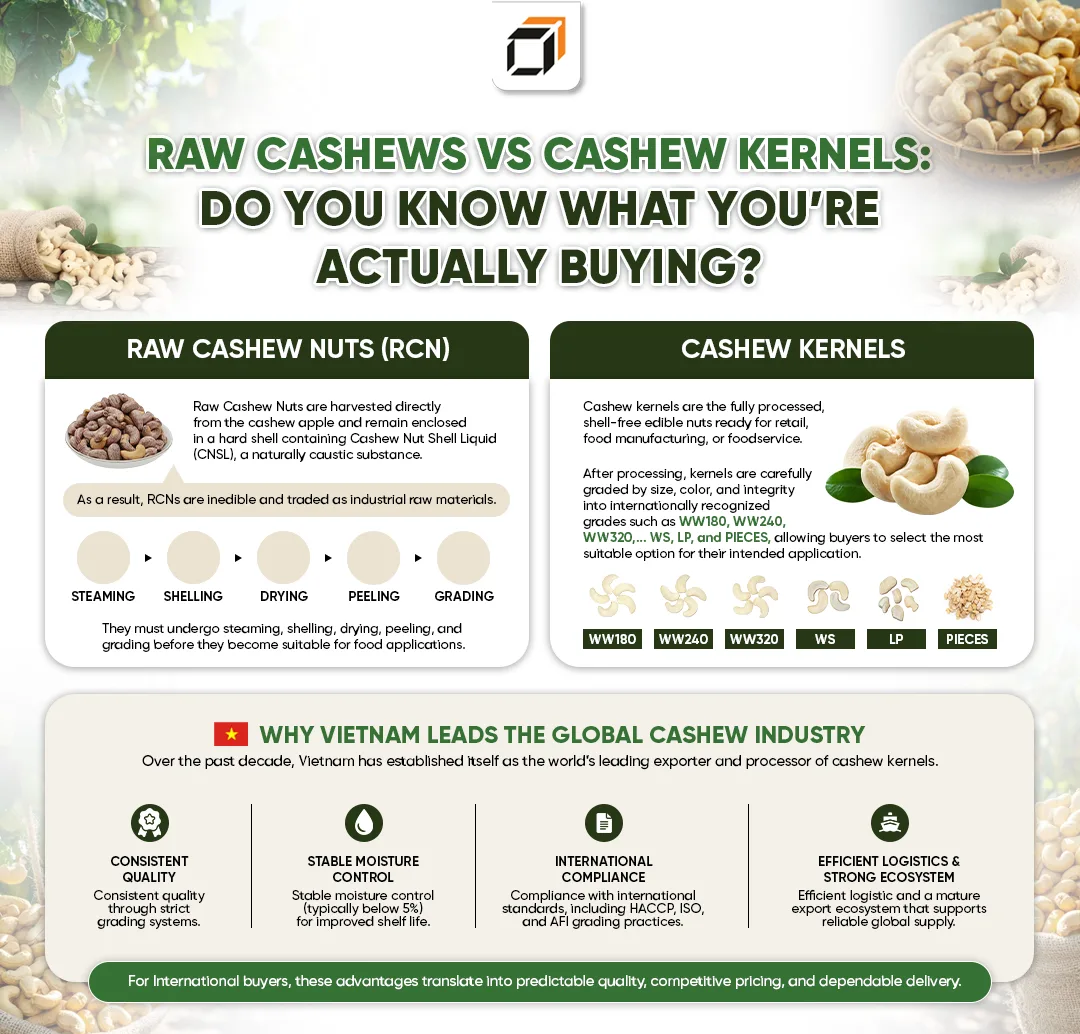
Raw Cashew Nuts are the seeds collected from the cashew apple immediately after harvest, still enclosed in a hard outer shell. That shell contains Cashew Nut Shell Liquid (CNSL), a caustic resin that makes the unshelled nut unsafe to handle or eat directly. Because of this, RCN is traded and classified as an industrial agricultural commodity rather than a food product, and it is bought almost exclusively by processors equipped to handle it safely.
Two steps in the journey from RCN to edible kernel tend to determine the quality of everything that follows. Steaming softens the shell and loosens the kernel from the CNSL layer, and getting the pressure and duration wrong here is one of the most common causes of kernel splitting later on: under-steamed nuts resist shelling and crack unevenly, while over-steamed nuts can darken the kernel and shorten its shelf life. Shelling itself, whether done by hand or with semi-mechanized cutters, is where whole-kernel yield is won or lost; a rushed or poorly calibrated cut is the difference between a shipment graded as premium whole kernels and one downgraded to butts and splits before it ever reaches a buyer.
Image suggestion — Alt text: Freshly harvested raw cashew nuts before industrial processing
What Are Cashew Kernels?
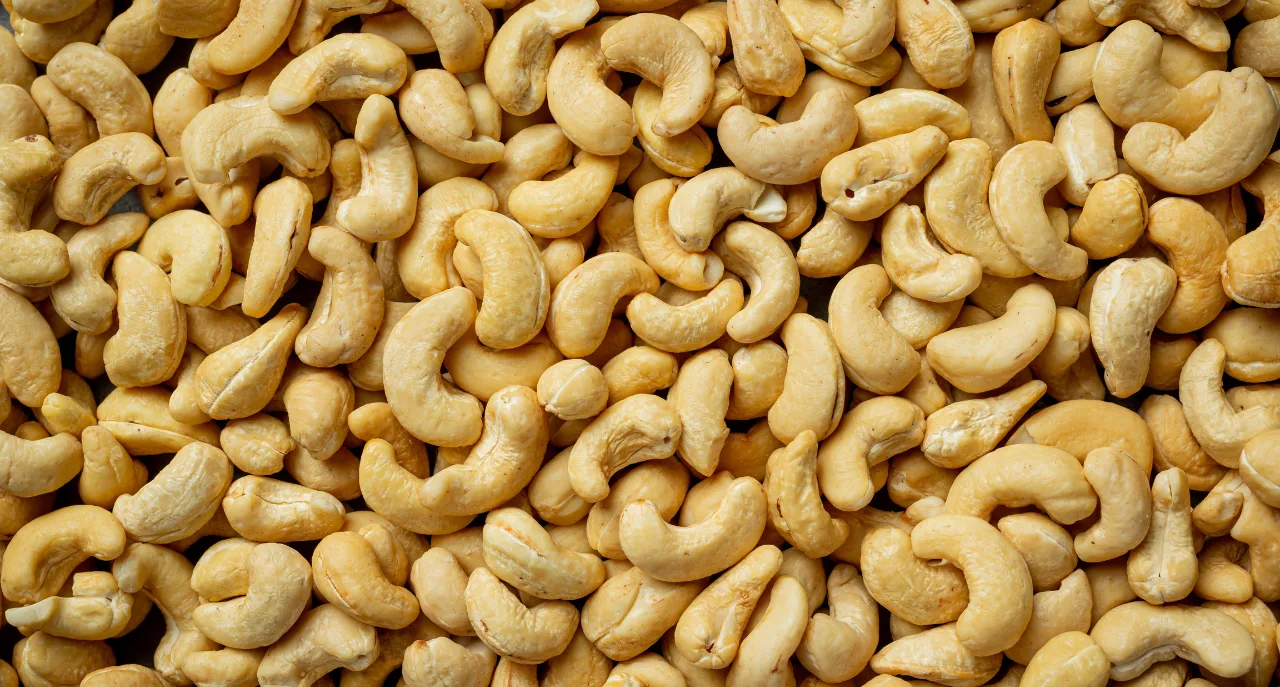
Cashew Kernels are what remain after the full processing chain: shell removed, kernel dried to a stable moisture level, peeled of its inner skin (testa), and sorted against internationally recognized grading criteria. Unlike RCN, kernels arrive ready for immediate commercial use, whether that means retail packaging or direct input into a manufacturer’s production line.
They show up across a wide range of end uses: retail snack products, bakery and confectionery, dairy alternatives and plant-based foods, nut butter, breakfast cereals, and foodservice.
Grading follows the standard maintained by the Association of Food Industries (AFI), the trade body most U.S. and international buyers reference in contracts. Under AFI rules, a kernel only qualifies as “whole” if it keeps its natural kidney shape and no more than one-eighth of it has broken off; anything beyond that threshold drops into a broken-kernel category such as butts or splits. The common export grades buyers will see on a spec sheet include:
- WW160, WW180, WW210, WW240, WW320, WW450… (white whole, graded by kernel count per pound – a WW180 kernel is larger than a WW450)
- SW (scorched whole)
- WS (white splits) and LP (large pieces)
- Smaller broken grades used mainly in industrial and bakery applications
The count in a grade name like WW320 isn’t arbitrary. It refers to roughly how many whole kernels make up one pound, which means a buyer sourcing for a premium retail bag and a buyer sourcing for an industrial nut-butter line are often looking at completely different grades even though both are technically “cashew kernels.”
For most buyers, the decision comes down to one question: Do you have your own shelling and processing facilities? A handful of large manufacturers with in-house processing lines do buy RCN directly, since it can lower landed cost when volumes are high enough to justify the investment. For most food brands, distributors, and private-label buyers, though, taking on shelling and grading in-house adds a layer of food-safety compliance and equipment cost that outweighs any savings, which is why the large majority of international buyers source finished kernels rather than raw nuts.
Why Vietnam Leads Global Cashew Kernel Exports
Vietnam processes an estimated 80% of the world’s cashew kernels, a level of concentration no other origin market has matched. That share didn’t come from volume alone. It reflects decades of investment in grading discipline, drying infrastructure, and food safety systems built specifically around cashew, not adapted from a broader nut or agricultural industry. The four factors below explain what that translates to from a buyer’s side of the table
Consistent quality through strict grading systems
Vietnamese processors sort kernels against the same AFI criteria referenced above, including size tolerances that cap the amount of lower-grade kernel allowed in a given batch (typically no more than 10% by weight for whole grades) and defect checks for scorching, discoloration, and blemish spots larger than 3mm. That level of discipline is what allows a buyer in Rotterdam or Los Angeles to order a WW320 from Vietnam and receive a batch that matches the spec sheet almost exactly, shipment after shipment.
Moisture Control Built Into the Process
Moisture is kept below roughly 5% through controlled drying, not left to whatever the ambient humidity happens to produce. This single number has an outsized effect on the buyer’s experience of the product: kernels above that threshold are more prone to rancidity and mold risk during a six-to-eight-week ocean transit, while kernels dried correctly arrive with the shelf life a manufacturer needs to plan production runs weeks or months in advance.
Compliance with international standards
Leading Vietnamese facilities operate under HACCP and ISO food safety systems alongside AFI grading, which means quality control happens at defined checkpoints throughout production rather than only at final inspection. For an importer, that translates into fewer surprises at the port and a paper trail that supports the traceability requirements of markets like the EU and US.
An Export Infrastructure Built Around Cashew Specifically
Vietnam’s processing capacity is concentrated in a handful of southern provinces, and Binh Phuoc alone is home to more than 1,400 cashew processing facilities, more than any other province in the country, with processing contributing close to half of the province’s annual export revenue. That density did not appear overnight. Vietnam had only three cashew processing factories in 1988; by 1999, that number had grown to 62, with combined capacity already reaching 250,000 tons a year. Today’s scale is the result of that build-out continuing for another two decades, which is why the country can absorb large, recurring order volumes without the quality slipping the way it might at a newer or smaller-scale processor.
Sourcing Cashew Kernels from Vietnam with FPT AdTrue Export
FPT AdTrue Export works with processing partners across Vietnam to supply cashew kernels across the full range of AFI grades, from premium whole kernels like WW240 and WW320… to broken grades suited for industrial and bakery use. Every shipment ships with detailed spec sheets, consistent grading, and export documentation support, and sourcing can be tailored to whether a buyer needs a single trial order or a recurring supply program.
If you’re evaluating a Vietnamese supplier for cashew kernels, reach out for current grade availability, spec sheets, and a quotation matched to your production needs.
FPT AdTrue Export Aug 2026 | Written by Lucas Tran